
Share your goals
Share what you want to evaluate. A short outline is enough to start the conversation.
FOR AI TEAMS
Bring software experts into code review, model-response comparisons and rubric development. Get documented judgments and visible disagreement to inform your engineering decisions.
Discuss your evaluation
Share what you want to evaluate. A short outline is enough to start the conversation.
We review your request, discuss project fit, and agree on the review approach before approving access.
Agree on the scope, review criteria, and deliverables with our team. Project access follows approval.
PURPOSE-BUILT EVALUATION
See the reasoning behind model performance. Connect each judgment to its artifact, reviewer, and rubric.
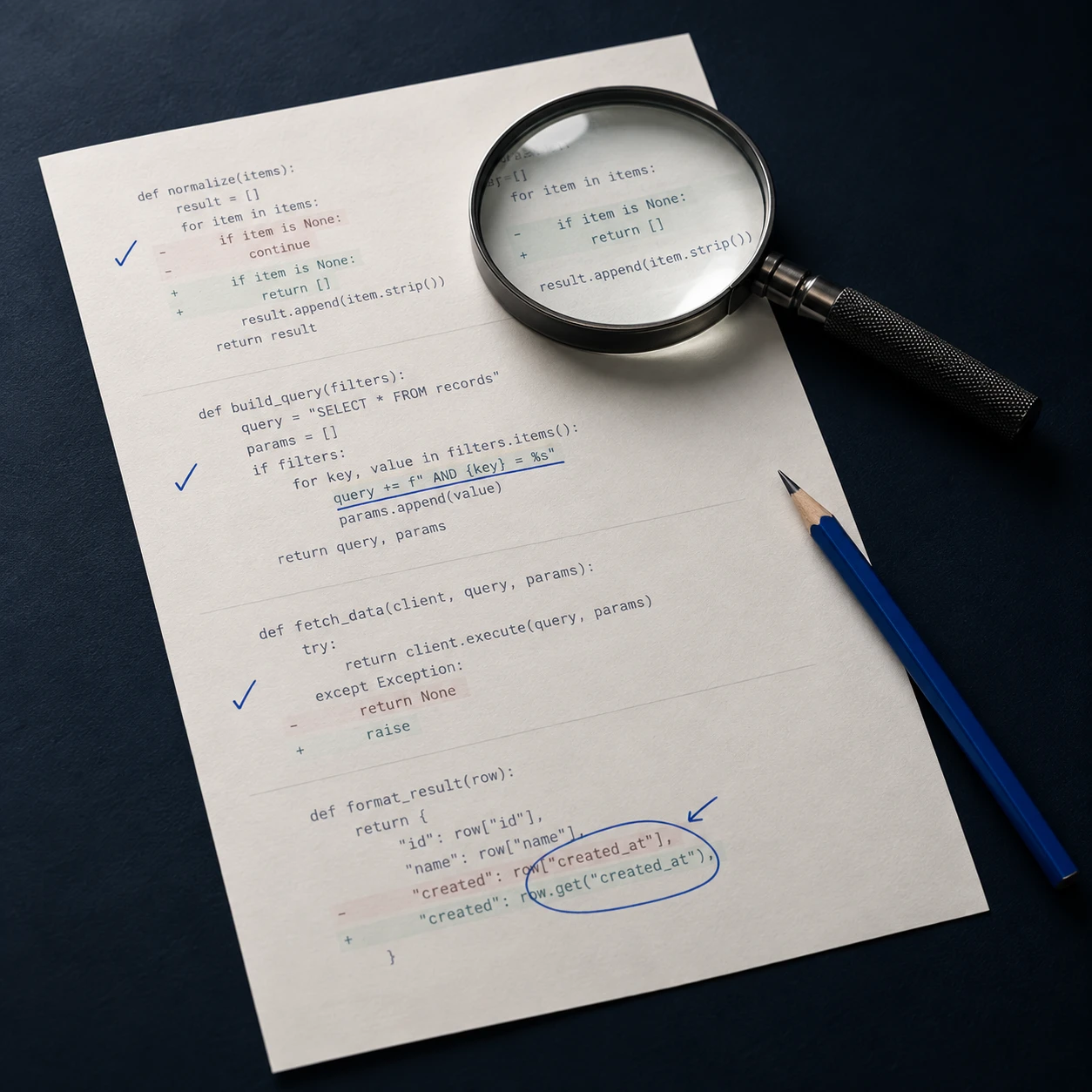
Review correctness, maintainability, instruction following, and security.
Compare two model responses with independent expert judgments.
Bring accepted records into your analysis with CSV and JSONL exports.
Across four criteria
Every score has context: the artifact, the rubric, and the reviewer’s reasoning.
4 + 5 + 4 + 5 = 18 out of 20, or an average of 4.5 out of 5.
Illustrative example · Not a published evaluation result.
QUALITY THROUGHOUT THE WORKFLOW
Choose the review around a decision: accept a generated patch, compare model versions, or improve the criteria used to judge an answer.
| Your question | Useful inputs | Evidence to agree in the scope |
|---|---|---|
| Does this code meet the requirement? | Code or diff, task requirements, relevant context and supplied test evidence. | Criterion-level findings, code references, severity and unresolved questions. |
| Which response better solves the task? | The same prompt and context, candidate responses, and acceptance criteria. | Blinded preferences, reasons, ties and recorded disagreement. |
| Are reviewers using the rubric consistently? | A draft rubric and representative examples, including ambiguous cases. | Calibration notes, unclear criteria and proposed score anchors. |
The agreed output can include item-level reasons, artifact references and CSV or JSONL fields for your analysis. A summary should state the sample’s limits and unresolved disagreements. See the worked example report before deciding what your team needs; it is an AI-assisted illustration, not a completed independent review.
Human review can examine requirement interpretation and trade-offs that an automated score leaves unclear. It complements your tests and operational measurements. The current service reviews supplied artifacts and evidence; hosted execution of client code is outside scope. An evaluation does not certify software as secure or defect-free.
Share the decision, programming languages, approximate sample size, deadline and access restrictions. Keep confidential code and data out of the initial form. We agree artifact handling, reviewer requirements, delivery scope and fees before starting.
Discuss your code evaluationSTART WITH A DEFINED QUESTION
See the inputs, deliverables, and scope we’ll agree together.